

HPLC Course for Women
Operation, Care, Trouble Shooting & Preventive Maintenance of HPLC Systems in Quality Control Laboratories
INTRODUCTION
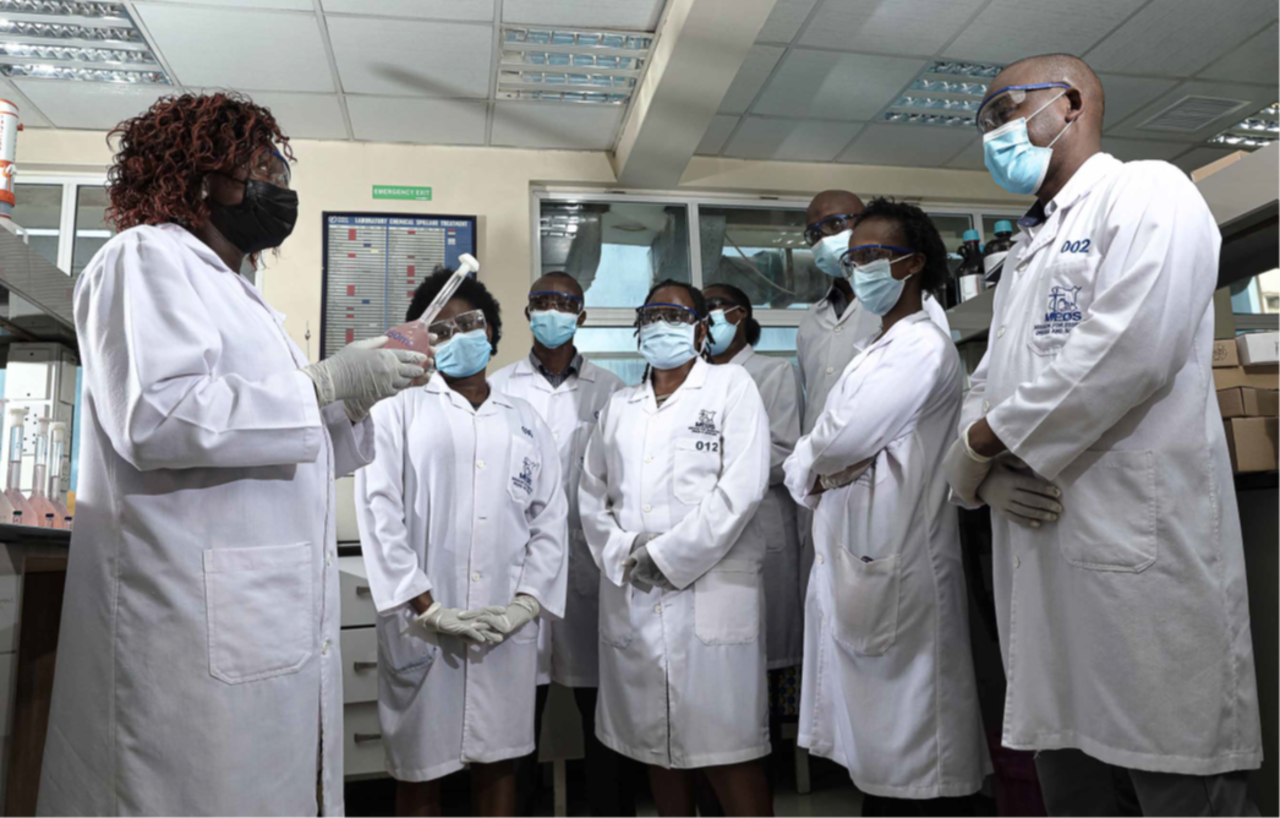
Mission for Essential Drugs and Supplies (MEDS) in collaboration with Physikalisch-Technische Bundesanstalt (PTB) and the African Medicines Regulatory Harmonization (AMRH) initiative has organized a unique and exciting training program targeting women Quality Control Technicians, Laboratory Analysts, Calibration Service Providers and other experienced laboratory technicians working in the pharma and food manufacturing industry as well as National Quality Control Laboratories or National Standards Bureaus from the African continent. The training seeks to address the challenge of efficiency in laboratory operations attributed to downtime of equipment and limited availability of qualified service engineers in the region with ability to maintain HPLCs. The objective of the course is to enable optimization of the use of HPLCs in industries to minimize breakdowns by building capacity on good practices and trouble-shooting guides.
ELIGIBILITY
Women scientists attached to pharmaceutical manufacturing units and laboratories, from both private and public sector, including those involved in Quality Assurance, Quality Control, Research, Method Development and pilot plants, domiciled within the Pan African member states.
OBJECTIVE
The course will focus on laboratory testing and its wider scope in quality assurance, with emphasis and focus on detailed techniques for QC equipment/instrument operation, preventive maintenance, troubleshooting, service, diagnosis, and repair.
EXPECTED OUTCOMES
Appropriately trained equipment maintenance personnel who are able to support the production and quality control functions in the local pharmaceutical industry.
A capability to develop effective programs for implementation of equipment preventative maintenance in local firms leading to less incidence of breakdown in critical quality control and production equipment.
Improved efficiency in operations and meeting customer obligations on a timely basis by avoiding delays associated with equipment maintenance.
Reduced reliance on foreign equipment maintenance engineers, which translates to savings for local companies.
COURSE DELIVERY
The course is designed to incorporate blended, self-paced learning with training material prepared beforehand by experts.
The two-part course involves an e-learning session with three modules (QC-001, QC-002 and QC-003); and a physical practical session.
In the e-learning session, learners will access the course content on an e-learning platform where lessons, discussions, forums, quizzes and assignments are available. Course facilitators will interact with learners via direct messages and/or discussion forums throughout the virtual sessions. Each module will begin and conclude with videoconference sessions bringing together learners and course facilitators. Participants will be provided with log-in credentials and be able to access the course at any time 24-hours a day.
The second part of the course will be a practical hands-on session at MEDS’ WHO-Prequalified laboratory in Nairobi, Kenya presenting an opportunity for learners to perform preventive maintenance under the supervision of trained service engineers.
COURSE TIMETABLE
Week 1 (21st October to 24th October 2025): Module QC 001 - Quality System for Laboratories (e-Learning)
| UNIT | TITLE | DESCRIPTION |
| 1.1 | Introduction to Chromatography | Introduction to the principles and the different types of Chromatography |
| 1.2 | Overview of High Performance Liquid Chromatography | To understand the HPLC process, including retention and separation mechanism, pH in HPLC and use of buffers |
| 1.3 | HPLC Components | To understand the components of a HPLC System including hardware, plumbing, tubing and fittings |
Week 2 (27th October to 31st October 2025): Module QC-002 Quality systems with GLP (e-Learning)
| UNIT | TITLE | DESCRIPTION |
| 2.1 | Good Practices for Quality Control Laboratories | Learn more about materials, equipment instruments and devices in the context of good practices in the quality control laboratory Learning about Good Laboratory Practices |
| 2.2 | Quality Managemen System | Learning about Good Laboratory Practices |
| 2.3 | Laboratory Equipment Management | Learn more about managing laboratory equipment; Management of out-of-Specification results and principles of ALCOA |
| 2.4 | Method Development by HPLC | Learn more about Method Development with different forms of separation |
| 2.5 | Check your knowledge | Informal quizzes to test your own knowledge and understanding |
Week 3 & 4 (3rd November to 14th November 2025): Module QC-003 (part 1) – Preventative Maintenance of HPLC (e-Learning)
| UNIT | TITLE | DESCRIPTION |
| 3.1 | Overview of HPLC system | Identification of different modules within a HPLC system |
| 3.2 | Understand the theory and basics of pump and degasser | Overview of pump & degasser with parts identification & operation Discussion of typical problems seen with pumps and applicable solutions covering Replacement of defective components |
| 3.3 | Understand the theory and basics of Auto-sampler and column compartments | Overview of operation of autosampler, flow path, parts ID and replacement of components within the autosampler & column compartment |
| 3.4 | Understand the theory and basics of detectors | Overview of operation of UV & DAD detector, replacement of lamps, flowcells and rebuilding flow-cells and re-calibration. |
PRACTICAL HANDS-ON SESSION (17th November 2025 to 21st November 2025) Module QC003 (part 2) - Preventative Maintenance of HPLC
| UNIT | TITLE | DESCRIPTION |
| 3.5 | Day 1 Practical Hands-on training. | PM of HPLC pump OQ/PV of pump |
| 3.6 | Day 2 Practical Hands-on training. | PM of Autosampler OQ/PV of Autosampler |
| 3.7 | Day 3 Practical Hands-on training. | PM of column compartment OQ/PV of column compartment |
| 3.8 | Day 4 Practical Hands-on training. | PM of detector OQ/PV of detector |
| 3.9 | Day 5 Practical Hands-on training. | OQ/PV of multi-channel gradient valve & OQ/PV of thermostatic auto-sampler. |
IMPORTANT DATES
| 21st Oct 2025 | Kick-Off meeting + Introduction to the Moodle course + Introduction to module 1 |
| 27th Oct 2025 | Q&A module 1 + Introduction to module 2 |
| 3rd Nov 2025 | Q&A module 2 + Introduction to module 3 |
| 10th Nov 2025 | Q&A module 3 + Logistical questions |
| 15th/16th Nov 2025 | Arrival of Participants In Nairobi |
| 17th-21st Nov 2025 | Practical Training In Nairobi |
| 21st/22nd Nov 2025 | Departure of Participants |
TRAINER
Ms. Mildred Wanyama (MEDS)
Ms. Claire Ogeto (Estec)
Mr. Paul Mwangi (Estec)
PTB CONTACT
Anna Reinhardt, Project Coordinator, anna.reinhardt@ptb.de
Lisa Köhler, Project Assistant, lisa.koehler@ptb.de